‘Scholars’ and ‘Solvers’: How Panaah offers a lifeline to the two extremes in school classrooms
In Pune’s low-income neighbourhoods, Panaah Communities is creating opportunities for the brightest students as well as those who need foundational help the most
Shehzil Khan wants to be Prime Minister of India when he grows up. Already, he’s got the promises on his manifesto planned out. “First of all, I will fix the air pollution problem in Delhi,” he says. “Second, I will clean up the Ganga.”
The Class 8 student also has a plan for how he will get his dream job. “After school, I will get into an IIT and study physics – it’s my favourite subject. Then I’ll work as an engineer and build a lot of contacts, which will help me get votes when I get into politics.”
At 13, Shehzil has already taken his first steps down this ambitious path. In November 2025, he appeared for – and aced – the Science Promotion Orient Test (SPOT), an annual competitive exam organised by the Vikram Sarabhai Science Foundation for school students across India. He ranked in the top 100 out of nearly 10,000 children. It is no mean feat for the son of a tempo driver living in a slum in Pune, Maharashtra. SPOT recognises excellence in science and an aptitude for space science, and winners get opportunities for mentorship, educational tours and scholarships, among other things.
What makes Shehzil’s achievement even more remarkable is that he is not alone. 17 of the top 100 SPOT rankers this year are boys and girls from a cluster of just five slum neighbourhoods in Pune, who attend either municipal schools or affordable private schools. The common thread for all 17 is that they are enrolled with Panaah Communities, an organisation that conducts after-school classes for children from low-income families in Pune.
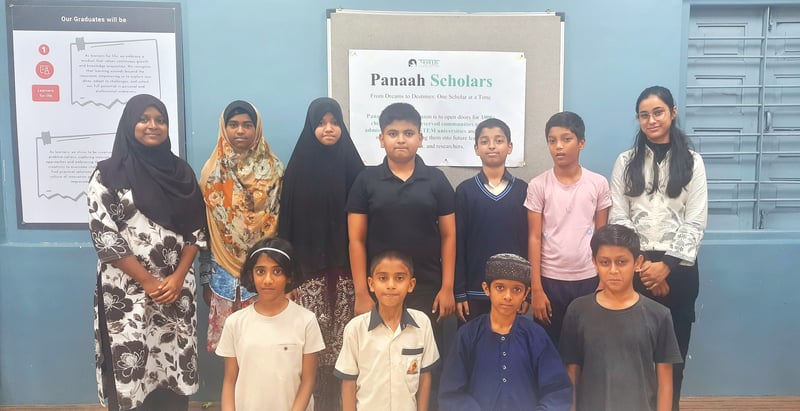
Founded in 2022, Panaah focuses its efforts on the two academic extremes in school classrooms: the brightest students, like Shehzil, who rank in the top 5% of their classes, and the ones who struggle the most with their studies, ranking in the bottom 20%.
The first group, part of Panaah’s ‘Scholars’ programme, receives accelerated learning opportunities – training and guidance to appear for a range of competitive exams like science and math Olympiads – with the aim of helping them get into elite colleges and high-paying careers. The second group, part of the larger ‘Solvers’ programme, receives rigorous coaching in foundational literacy and numeracy to help them improve at school and get a chance to succeed in their professional lives. This programme also helps school dropouts return to education, and is unique because of its innovative project-based approach to foundational learning.
In the past four years, Panaah has established six training centres across Pune, serving over 1,000 children from low-income neighbourhoods.
“Young people from these communities often end up in working class jobs or in the gig economy, but for their families to come out of poverty, they need to be qualified for jobs with higher pay,” said Panaah co-founder Sayed Mohammed Shoeb. “One concrete pathway towards this is to get into high-quality colleges, which we enable by giving young students high-quality education.”
The backstory
Shoeb began his own journey in a one-room home in Mumbai, where he grew up attending an affordable private school. He did well enough to get into an engineering college in Pune, and earned a small income on the side by tutoring school students at home. By the time he graduated in 2018, he realised that his true calling was not engineering, but teaching.
“Thanks to education, my family managed to break the cycle of poverty. But I always asked myself what my life would have been like if I had been born in the home of my neighbours, who are still trapped in that cycle,” Shoeb said. “I knew I wanted to help other young people change their future.”
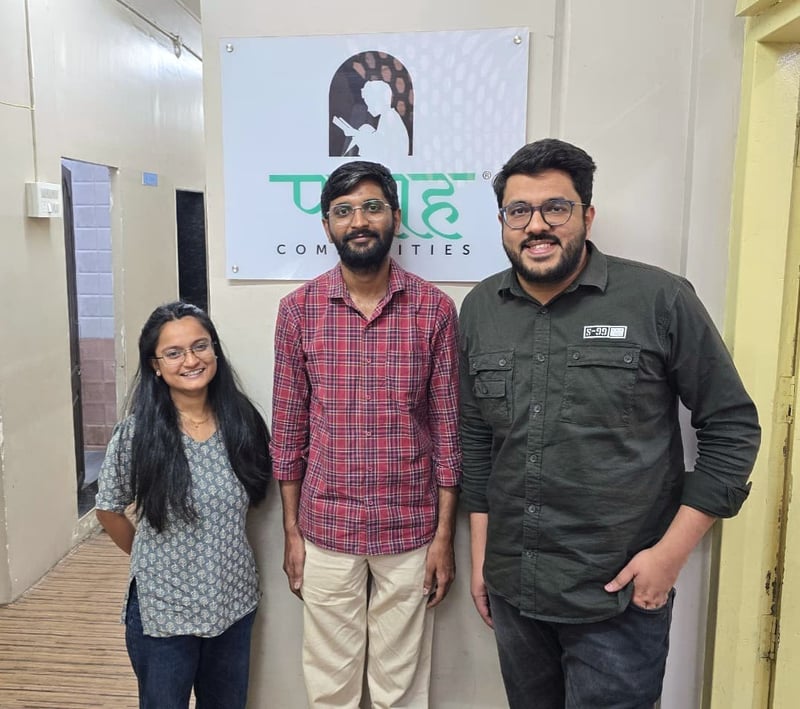
For nearly two years before the onset of Covid-19, Shoeb and his friend Hasnain Naqvi ran a small after-school programme to help students with self-study. Then, in the throes of the pandemic, he became a Teach For India fellow, conducting online lessons for Class 6 students of a Pune municipal school. The experience rekindled Shoeb’s desire to build a strong educational support system for underserved children, and he co-founded Panaah with Naqvi and two of his Teach For India colleagues, Aarshiya Das and Ankita Pande.
The team started with their foundational learning programme for 45 children in Pune’s Lohiyanagar slum, where the average income in most households is Rs 20,000 a month. Since then, Panaah has rapidly expanded. Today, across six centres, it has 600 students from Class 4-10 enrolled in the Solvers programme and 94 children from Class 5-8 in the Scholars programme. The Solvers programme also includes Pathmakers, a reintegration track that helps children who have dropped out return to school and work towards their board exams. Panaah’s third vertical, the Professionals programme, helps young adults transition into skill-based careers.
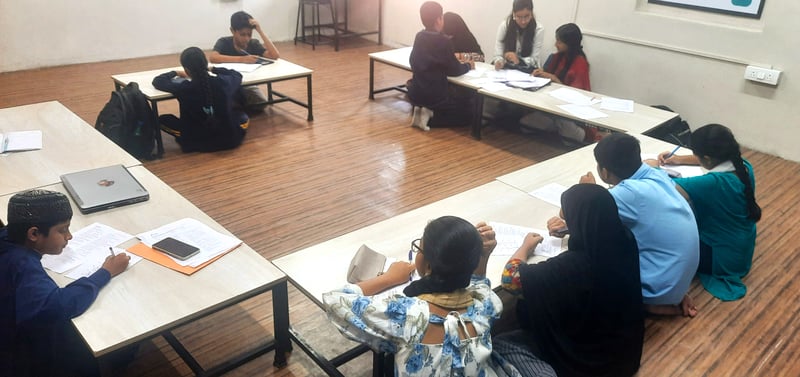
The programmes are largely run by Panaah’s team of 30 mentors, who are given up to eight hours of training a week in Panaah’s approach to education, directly from the organisation’s founders. Many of the mentors are college students, and a large number of them come from the same neighbourhoods as the children they teach.
“Because we share the same background, the children find it easier to connect with us – we feel like family,” said Alisha Pathan, an engineering student and a mentor in the Scholars programme. “These children are exposed to a lot of negativity and violence around them, but we are able to create a safe space for them to share their problems. And having this space helps them do better in their studies.”
A neighbourhood directory
The impact of the safe learning environment created by mentors is evident at Panaah’s Lohiyanagar centre, where at least 100 Solvers’ students from Class 4-7 study in batches every day.
In one of the spacious rooms of the centre, 12-year-old Soham Jadhav sits cross-legged on the floor with six of his Solvers batchmates. They are bent forward in concentration, sticking dozens of business cards on a large chart paper – a visual demonstration of the success of their pioneering ‘business directory’ project.
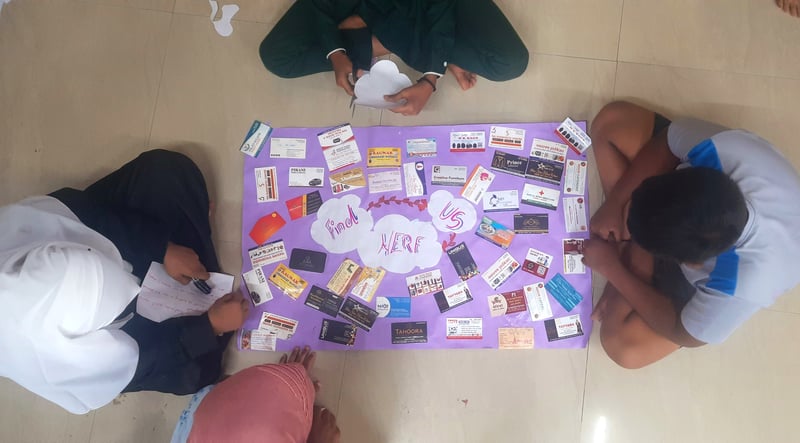
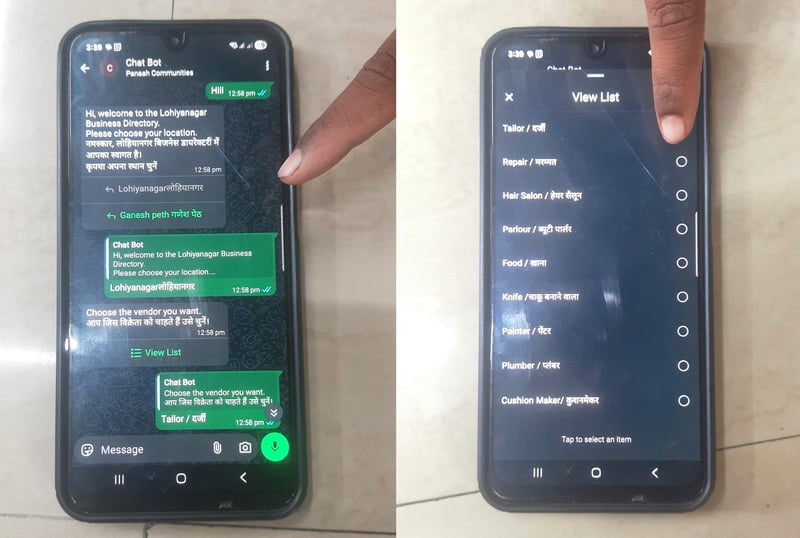
At the start of every academic year, mentors in the Solvers programme introduce a “problem” to each of their batches – a real-life civic or local issue that students are required to devise solutions for. This year, Soham’s batch was confronted with a problem common among small business owners in their slum: poor visibility in the community and almost no online presence, which made it difficult for their businesses to grow. After weeks of talking to vendors and brainstorming with their mentors, the students came up with a solution: they would create a chatbot that would serve as a directory for their neighbourhood to find local plumbers, tailors, barbers and other businesses. For a population with limited digital literacy, they agreed that Whatsapp would be the most convenient platform for the bot.
“Our didis and bhaiyas [mentors] taught us how to make a chatbot from scratch, and we learnt a lot in the process,” said Soham, proudly displaying the functions of the bot on his mentor’s cellphone. The interface is simple, allowing users to first select one of the two slums covered by the project, then choose the type of business or service they need. The categories covered range from salons and repairmen to knife sharpeners and cushion makers. Once a business is selected, users get a full list of individual vendors in the area, with their contact numbers and addresses.
“We went all over our neighbourhoods to collect this information, and we are advertising our chatbot through local posters,” said Soham. So far, nearly a hundred businesses are listed on the bot, which is actively being used by local residents. “Already, businesses are telling us our project is helping them.”
Can such projects effectively help children with foundational literacy? When students join Panaah’s Solvers programme, they typically struggle with basic reading and maths, lagging behind their classmates in school. Making a chatbot may not seem like the obvious method to help them improve, but Panaah mentors swear by the project-based approach.
“Most children are poor at school because they severely lack self-esteem, and they are constantly discouraged,” said Aarshiya Das, Panaah co-founder and director of the Solvers vertical. “Participating in projects that have meaning for their lives and communities helps them realise that they have potential, that they can make a difference. It boosts their self-confidence and eagerness to learn, which automatically impacts how quickly they improve their literacy and numeracy skills.”
Of course, mentors also make sure to incorporate maths and reading lessons directly into their projects. One batch of Solvers, for instance, is trying to address chemical pollution in their local river by creating prototypes of chemical-free soaps and detergents for the community. To arrive at this solution, they had to read up on the history of the river, learn how it got polluted, and carry out experiments.
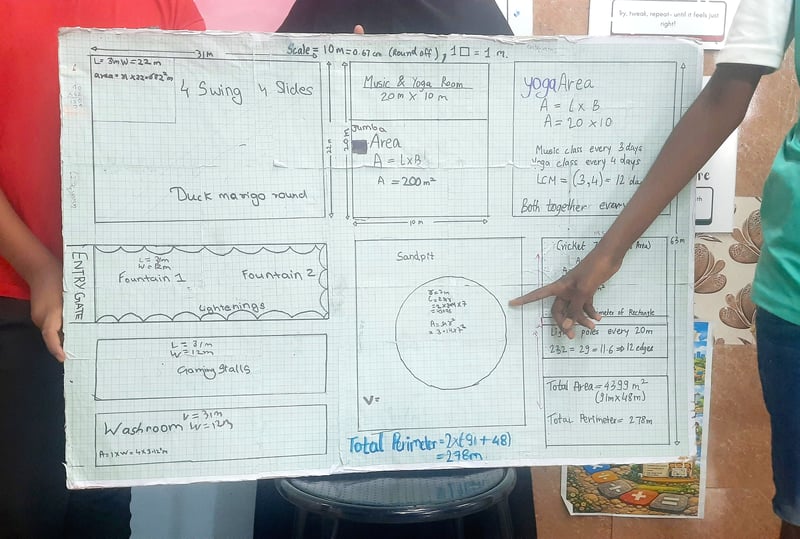
Another batch has created a blueprint for a playground in their slum. This involved identifying an actual empty plot in the vicinity, measuring it, and drawing up plans, to scale, for a play area, a cricket pitch, a yoga zone, fountains and more. “For this they had to learn a lot of maths calculations, which they picked up quite fast,” said their mentor Aisha Sheikh.
According to Das, the project approach has helped most Solvers students bridge their learning gap within a year, and some Solvers have also gone on to qualify for Panaah’s Scholars programme for high-achieving children.
The Scholars
The Scholars programme was created as a response to what co-founder Naqvi describes as the “law of averages in schools”. Teaching methods in most schools, he says, are designed for academically average students, which results in India’s widely reported problem of poor foundational learning. “But we noticed that in disadvantaged communities, even the top performers in a class suffer. They don’t get opportunities to grow their talents and excel, and they start becoming mediocre,” said Naqvi.
Panaah chose to design the Scholars programme with a specific focus on STEM – science, technology, engineering and mathematics – since these fields make up 70% of the highest-paying jobs across the world. “After Class 12, we want our students to make it into the top 5% of India’s STEM institutes,” Naqvi said.
This particular goal also informs the Godrej Foundation’s Tomorrow Makers platform, which is designed to connect talented students from disadvantaged backgrounds with educational opportunities that they deserve but often lack access to. Through an online registration and assessment process, Tomorrow Makers places selected students in programmes in the fields of science, innovation, arts and defence services.
Panaah prepares its Scholars for at least 17 different national and international competitions, including various STEM olympiads, the Aryabhatta and Bhaskaracharya maths competitions, and exams such as SPOT, which Shehzil aced. Some of these are government-supported platforms, while others are private.
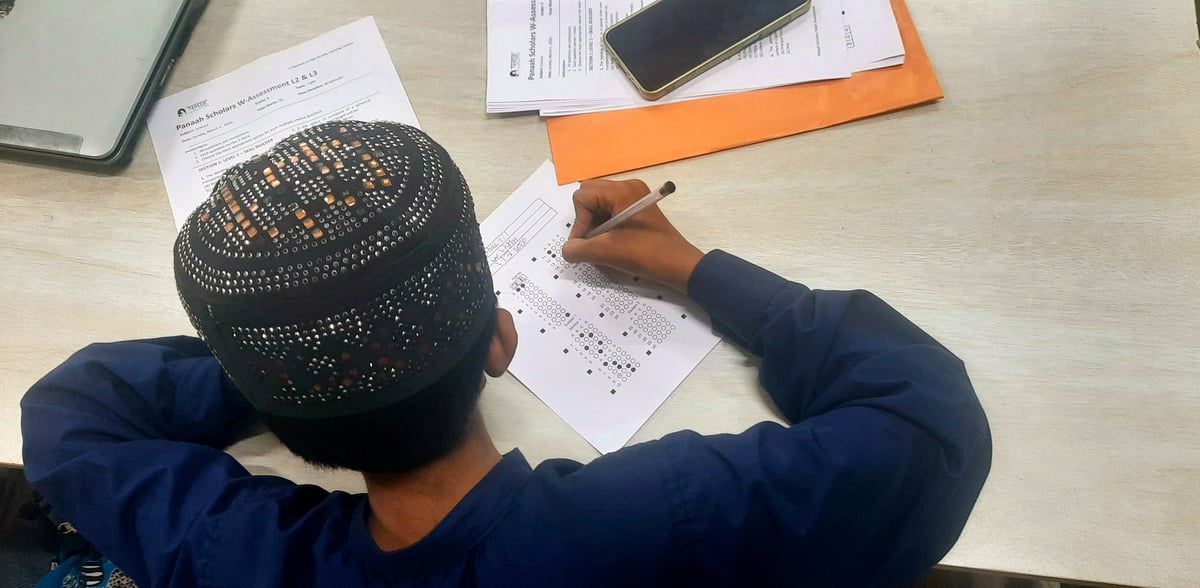
In Scholars classrooms, students receive regular guidance and help from mentors, but also specialised lessons from more senior experts, such as doctoral students and faculty from various IITs. Every day, children solve worksheets with multiple-choice questions about science and maths – questions that are easily a grade or two above their regular school curriculum.
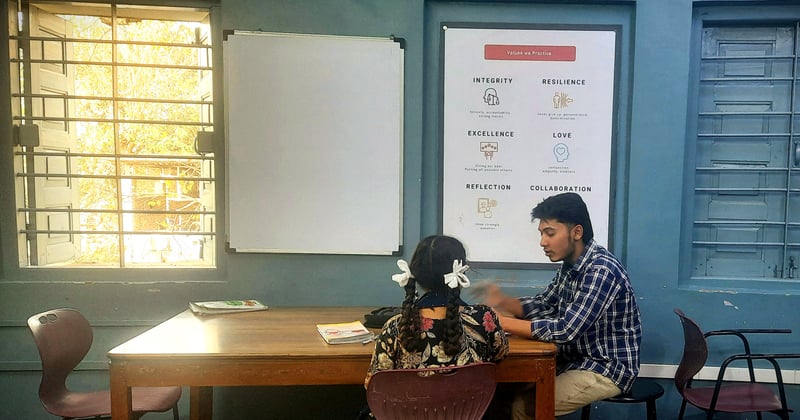
“I like coming to Panaah because we get to study things that are very different from what we do in school,” said Arnav Dongre, a Class 7 student and an aspiring businessman who wants to study economics. “The teachers here are very good at making difficult topics feel easy.”
The results have been impressive, and not just in the case of the 17 Scholars who ranked in the top 100 of the SPOT exam this year. In the Unified International Mathematics Olympiad, for instance, all 34 of Panaah’s participating scholars placed within the top 1,000 globally. In the Science Olympiad Foundation's national olympiads, two Class 5 Scholars advanced to the second round reached only by top performers, and seven placed among the top 1,000 globally.
In the 2026 TALLENTEX Exam conducted by the Allen Career Institute, 10 of Panaah’s students exceeded the national average scores, which the Institute’s own index flags as having strong potential for the JEE track. In fact, after Class 10, Panaah intends to channel many of its Scholars to organisations like Avanti Fellows, which provides rigorous coaching for engineering and medical entrance exams, free of cost, to aspirants from low-income households.
While Scholars have more defined pathways towards professional success, Panaah aims to ensure that all its students, including Solvers, receive support and exposure to help them build well-paying careers. In 2024, the organisation launched its ‘Professionals’ programme, to prepare students from Class 11 onwards for the job market by giving them skills and exposure they wouldn’t otherwise get access to.
The programme has 250 students enrolled this year, and some of the skills they are taught include entrepreneurship, AI and coding, and filmmaking.
“We study Pune’s own economy to identify the five highest-paying sectors and the roles within them, and then we design real experiences around those careers,” said Shoeb. “A college degree on its own no longer makes a young person employable. Our job is to give them everything college doesn't have: exposure, mentors, practical skills, so that by the time they finish, they are a genuinely strong candidate in the job market. Young people from low-income communities often don’t even consider these careers. We want them not just to consider them, but to be ready for them.”