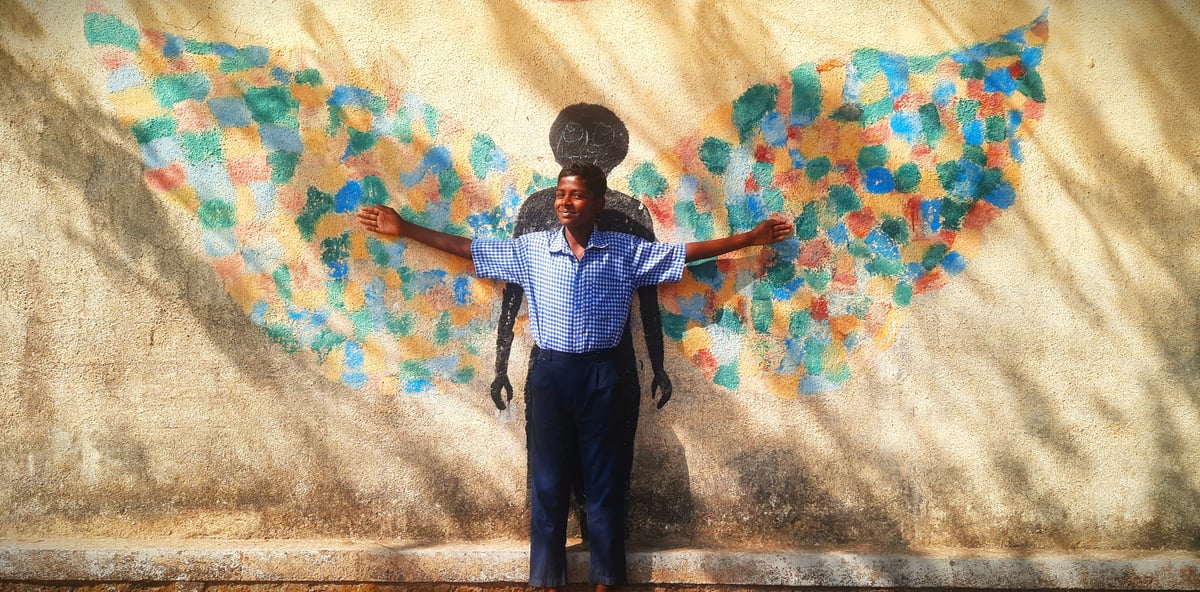
Reimagining the arts: Slam Out Loud’s programmes are transforming how children learn self-expression
In addition to helping students build confidence, empathy and critical thinking, the organisation is giving gifted young artists opportunities to build a future in the arts
“माझं घर हे निसर्गसौंदर्यात वसलेलं आहे. माझ्या गावाचं नाव धरमपुर. माझ्या घरामागून सूर्य नावाची वाहणारी ती खळखळ नदी, जंगलातून येणारं धुके, त्या नदीमध्ये असणारी बेट, त्या बेटांमध्ये असणारी अनेक विविध झाडं…”
“My home lies in the lap of nature. My village is called Dharampur. Behind my house is the gurgling Surya river, with mist rolling in from the jungle. There are islets in the river, and on them, myriad trees…”
The opening to Mangesh Valvi’s story, originally in Marathi, is enough to transport his listeners to a different realm. It is descriptive and nostalgic, and vividly evokes the sights and sounds of the forest in Maharashtra’s Dahanu tribal belt—a place far removed from the stage where Mangesh first narrated the story in December 2025.
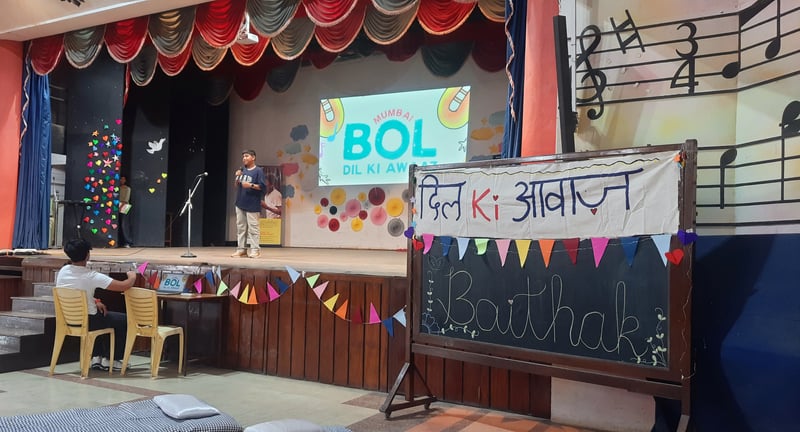
That stage was at the Govandi Arts Festival, a community-led arts and culture event in a Mumbai suburb known for its large slum population. Mangesh’s audience – largely young students – were rapt, and responded to his story with applause and cheers. Mangesh, a 13-year-old himself, was equally enraptured by the crowd, the bright lights, and the large LED screen behind him on stage. A month later he found himself storytelling on an even bigger platform – the Kala Ghoda Arts Festival in south Mumbai.
Being on such stages was not something Mangesh could have dreamt of as a young child. He was born in a Warli tribal hamlet in rural Thane, 150 km north of Mumbai, the son of a single mother who works as a farm labourer. To ensure that he was well-fed and received a stable education, his mother enrolled him at the Betegaon Government Ashram School, one of 550 ‘ashram’ or residential schools set up by the Maharashtra government for children from Adivasi communities. Mangesh’s teachers had always praised the essays and stories he wrote in class, and that was enough for the soft-spoken boy.
Then last year, as he began Class 8, his art teacher selected him for a new extra-curricular programme called Gifted Young Artists. The programme is run by Slam Out Loud, an organisation that works to reshape arts education for marginalised children in five states across India. Gifted Young Artists is part of Slam Out Loud’s larger vertical for platforming and mentoring students with high potential in the arts, and for its first batch, the organisation chose 113 students with exceptional talent or high potential in different art forms – visual arts, storytelling, rap, poetry, dance, music and theatre – and helped them hone their skills through online mentorship sessions with professional artists. Of them, 54 students were from Maharashtra, including Mangesh.
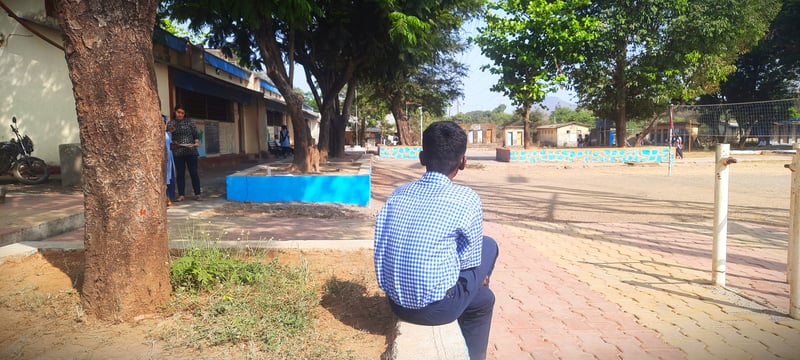
For most of the academic year, Mangesh was given access to his art teacher’s cellphone so that he could attend weekly video lessons with his storytelling mentor, a creative writing professional. “He taught me many new things, like how to bring your own voice to a story, how to create characters and bring out their emotions, and how to narrate well on stage,” said Mangesh. “It really helped me improve my writing and become more confident.” He put everything he learnt into practice when Slam Out Loud gave him the opportunity to travel to Mumbai and perform at the Govandi and Kala Ghoda arts festivals.
For Slam Out Loud, such opportunities to showcase talent are a key part of its platforming and mentoring programme. So far, 101 students from the programme have been platformed at 24 arts and culture events, including Kala Ghoda, Literature Live and Spokenfest in Mumbai, the Kochi Biennale, the Bengaluru Hubba Speaklore, the Himalayan Writing Retreat and the Orange City Literature Festival in Nagpur.
“We find that stage performance helps to build not only public speaking skills, but also a child’s confidence, which is very important for their holistic development,” said Gauri Konanoor, the senior associate for platforming and mentoring at Slam Out Loud.
This all-round creative, social and emotional development is at the heart of all of Slam Out Loud’s work with children, both within and outside the programme for high-potential youth.
Reimagining art
Jigyasa Labroo had grown up as an introvert in 1990s Dharamshala. It was a caring teacher who helped her find confidence and explore her talents, and a perceptive mother who took her to cultural gatherings, encouraging her to recite poetry. Labroo found that she wanted to do the same for other children, which is why she founded Slam Out Loud in 2017.
Before that, she had been a Teach For India fellow from 2014 to 2016, teaching children from low-income homes at a Delhi school. “As a young teacher, I saw how poetry, music and storytelling could make children who were otherwise silent begin to speak, imagine and see themselves differently,” said Labroo. “If children had this much to say and create, what might become possible if they actually had sustained access to the arts?”
Slam Out Loud was based on the conviction that the arts should not be a privilege, and that it has the transformational power to build children’s confidence, communication skills, critical thinking and empathy.
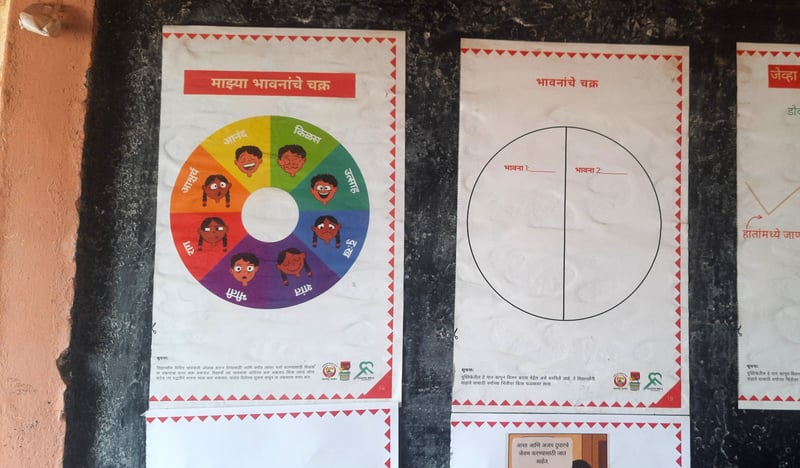
The organisation has carried out this work by creating its own art curriculum for secondary schools, which is then customised based on the needs of different states. The curriculum moves beyond basic drawing, colouring and painting to include multiple forms of expression – visual, written and performance – within the art classroom. The art forms function as tools to develop children’s Social Emotional Learning or SEL, which is now a part of India’s New Education Policy. Through storytelling, music, movement and drawing, children are taught how to identify, express and regulate their emotions, develop curiosity and imagination, and make the best use of their agency.
The Fellowship
Slam Out Loud first began its SEL work in 2017 at public and affordable private schools in Delhi, through its Jijivisha Fellowship programme. Based on the Teach For India model, this fellowship inducts a cohort of 20-30 art mentors every year, who serve as art teachers for secondary school students. The Jijivisha Fellowship is now active in 10 schools in Delhi, Mumbai Pune and Bangalore, reaching nearly 2,200 students.
In Jijivisha classrooms, fellows follow Slam Out Loud’s broad arts curriculum while creating their own weekly lesson plans. To build children’s emotional regulation skills, for instance, fellow Pari Baghar shows her class a picture book of personified emotions and asks them, “If your happiness were an object, what would it be?” The students – Class 9 teenagers in Mumbai’s Mohammed Umar Rajab School – are quick to list out their desires: cellphone, money, bed, shoes. Baghar then asks them to write a poem on what their feelings would do as those objects, and the students grow pensive and quiet.
“We’ve never had such an art class before—it’s very interesting and very enjoyable,” said Alifya, one of Baghar’s students. “Earlier, art class was just about drawing, but now we do all kinds of things, and the teacher asks us about our feelings, which no one else does.”
The impact of such SEL activities is not easily measurable, but Slam Out Loud has created an insightful set of rubrics to assess children’s progress. They help Jijivisha fellows track students’ understanding of various social and emotional concepts through the depth and complexity of approach they bring to their art work and their classroom interactions.
State collaborations
With the success of the Jijivisha Fellowship, Slam Out Loud scaled up its reformation of the arts through collaborations with various state governments. In 2022, the organisation rolled out its arts curriculum in over 1,000 public schools in Punjab, training nearly 50 art teachers across 23 districts, who then further trained other art teachers across the state. The Punjab programme reaches more than two lakh students, and a similar collaboration is now underway with the Bihar state government.
In Maharashtra, Slam Out Loud works specifically with the state’s tribal development department and its ashram schools, where the team has trained 410 art teachers since early 2025. While schools in Punjab use traditional folk dances and music as customised modes of expression, art teachers in Maharashtra’s ashram schools weave SEL into local art styles, such as Warli and Gond painting.
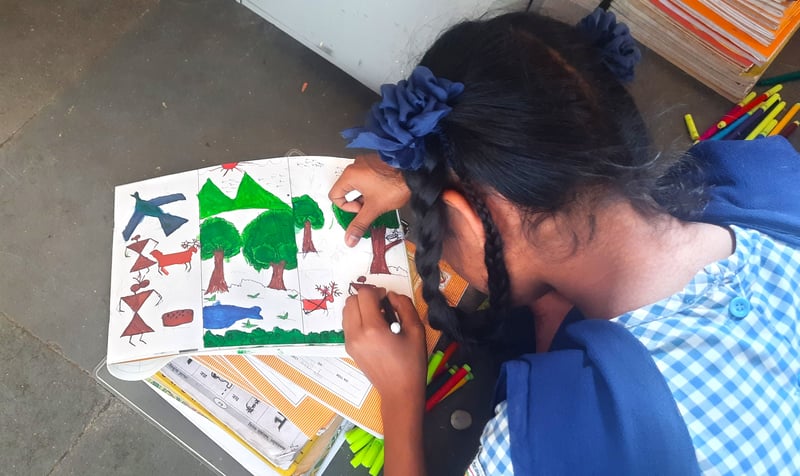
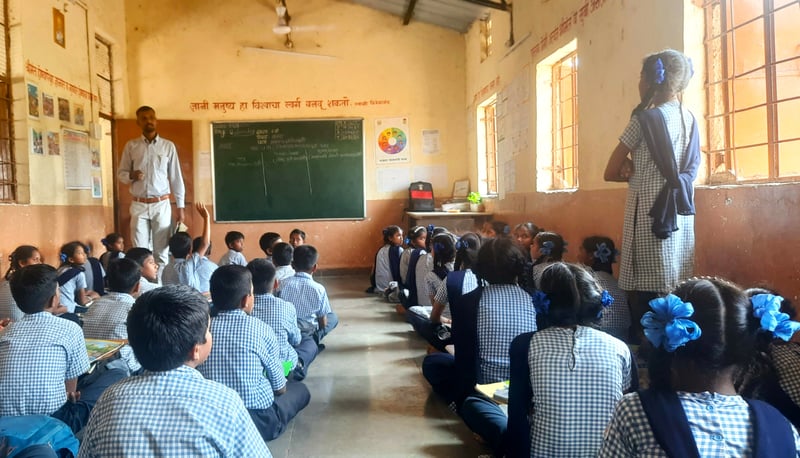
In Mangesh’s school, for instance, art teacher Sushil Pagdare begins a lesson with Class 6 students by asking them to close their eyes, take a deep breath, and think about a time they felt the happiest. The children are sitting in tight rows on the floor of one of their dormitories, which double as classrooms during the day, but in that moment they show no signs of feeling cramped or uncomfortable. When they open their eyes, Pagdare asks them to share their happy memory with a friend in the class. He then proceeds with a ‘chitrakatha’ exercise – storytelling through pictures. He narrates a fable about a woman saving a deer trapped in a net, and asks the class to draw key events from the story in Warli style. Finally, the children are encouraged to put themselves in the story: what would you do if you were in the woman’s place?
“I was not aware of SEL before Slam Out Loud trained us,” said Pagdare, who has been teaching art at the Betegaon ashram school for four years. “I have seen students become a lot more expressive about their feelings ever since I started using this method.”
A future in the arts
In addition to the development of confidence and self-expression, Slam Out Loud witnessed how children with exceptional artistic potential were able to thrive when they had access to holistic arts education.
Over the years, the organisation did what they could to support and platform these students’ talents. Some, like 13-year-old Deepak Kumar from Punjab, were flown to cultural festivals halfway across the country to perform songs. For 15-year-old Abbas Ali from Delhi, Slam Out Loud produced a Youtube video to showcase his poignant narrative poetry about mental health.
Such platforming, Labroo points out, plays an enormous role in validating a child’s identity as a young artist, and instilling a sense of pride in them for having created something of their own. “There is an inside-out journey of confidence and artistic identity, and an outside-in journey where the world responds to their work and tells them that what they make has value. That combination is very powerful,” said Labroo.
After showcasing their art on public platforms, however, was there a pathway for talented children to really earn a living and make a future in an art form of their choice? Slam Out Loud’s Gifted Young Artists programme was born out of an attempt to answer this question.
“In India, even a child from a low-income family who is very good at science or mathematics can imagine a fairly legible pathway ahead. If that same child wants to become a poet, dancer, theatre-maker, designer or artist, the pathway is much harder to see, and often actively discouraged,” said Labroo. “We wanted to build the infrastructure around that talent: excellent mentors, practice, exposure, platforms, networks and eventually pathways into education and work in the arts and humanities.”
A part of Godrej Foundation’s Tomorrow Makers initiative, the Gifted Young Artists programme gives high-potential young artists online training and mentorship in different art forms, and exposure to the kind of events and platforms that could allow them to one day build a career in the arts. For children from less privileged homes, in particular, these opportunities could transform not only their own lives, but also lift their families out of poverty.
In Maharashtra’s ashram schools, art teachers believe there is a clear and accessible path forward for their high-potential students, particularly in the visual arts.
“Folk art is a part of tribal culture in a lot of the communities here, and today, styles like Warli and Gond are getting global commercial recognition,” said Sanjay Durgawad, the art teacher at Mundhegaon Government English Medium Ashram School in Nashik district. In recent months, he has taken some of his students to a number of art festivals and exhibitions in Nashik and Nagpur, where they saw tribal motifs typically painted on village walls being printed and sold on bookmarks, bags and other merchandise. “If our talented children keep getting this kind of exposure, they can do this art themselves and build well-paying careers in this field.”
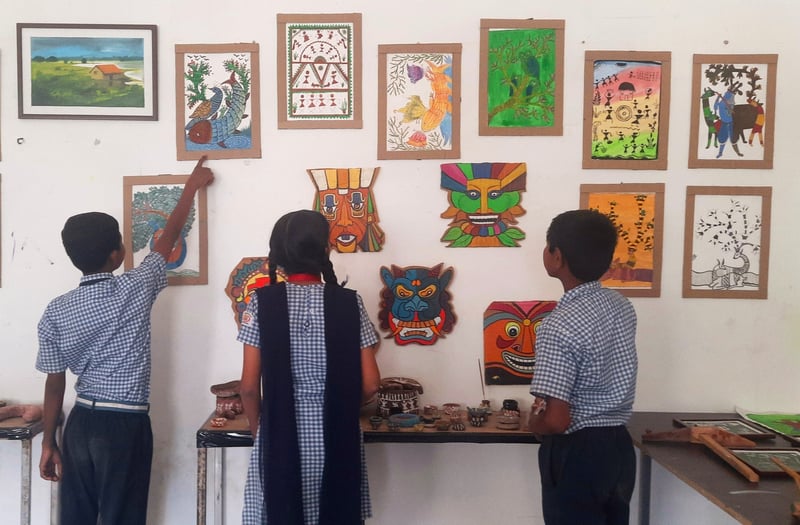
One of Durgawad’s students is 13-year-old Prince Nimbare, who was selected for the Gifted Young Artists programme last year and dreams of becoming a visual artist when he grows up. “My mentor has taught me all about backgrounding, foregrounding, how colours work, and other things I did not know about before,” said Prince. “I am good at Warli art, but I want to learn sketching, portraiture and computer graphics too, so that I can sell my art to others.”
Labroo’s vision for Slam Out Loud’s programme for high-potential young artists is clear: she wants it to become a true accelerator for young people from low-income communities who wish to pursue the arts and humanities seriously. “The ambition is to connect exceptional talent to the best mentors, institutions, stages, scholarships, residencies, learning opportunities and eventually careers, so that circumstance does not decide whose artistic potential gets to flourish,” she said.