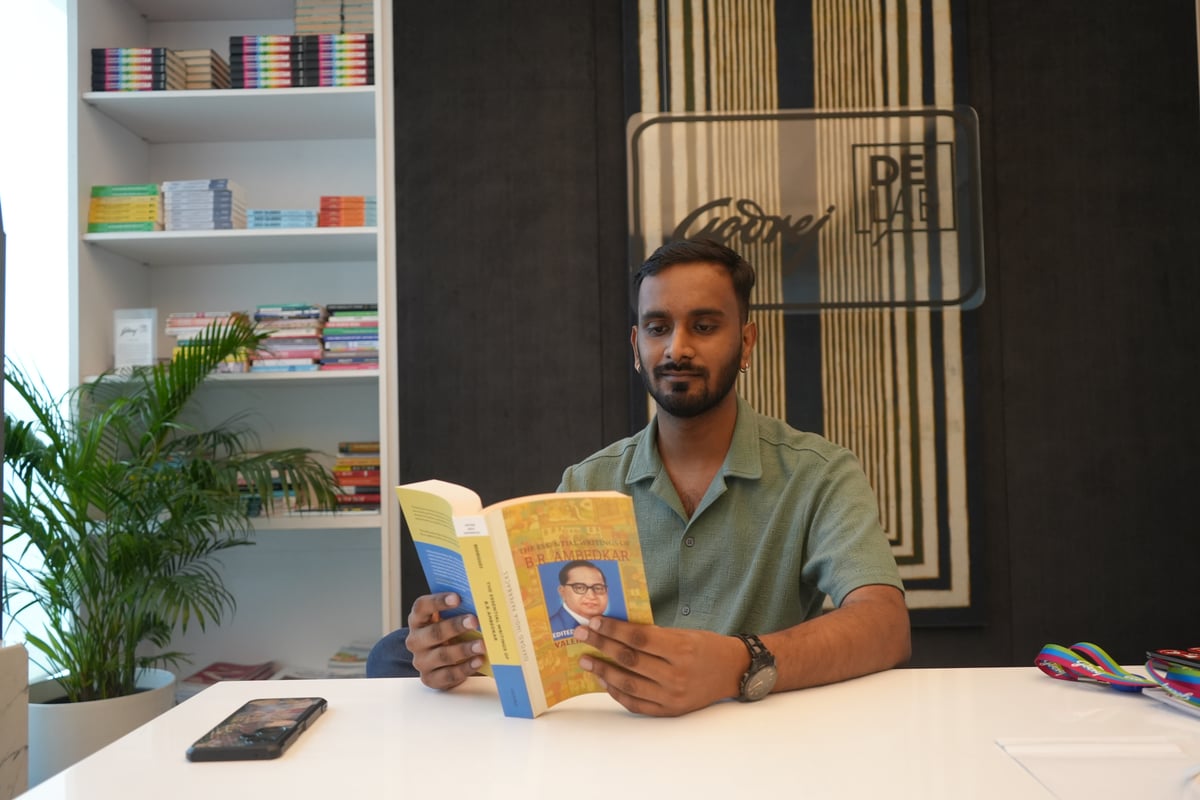
It's 14 April 2026, the 135th birth anniversary of Dr B.R. Ambedkar. It's also the day we're launching the Queer India Fellowship (QIF), a 12-month programme that will work to advance India's future queer leaders. When we think of Dr. Ambedkar, we remember the Constitution, his leadership of India’s long struggle against caste discrimination, and his relentless pursuit of social justice. His contribution to our rights as individual citizens is fundamental to our lives. But modern Indian families and workplaces also owe much to his contributions to progressive Indian legislation, regarding working hours, leave entitlements, safety protocols, maternity benefits, and more. His ideas and work anchor many efforts towards greater diversity, equity and inclusion in Indian institutions.
They are also significant in the wider movement for the progress and prosperity of the LGBTQIA+ community – something we hope to advance through QIF. So the launch of our fellowship on Ambedkar Jayanti is no coincidence.
Until I moved to Delhi for my undergraduate studies, I lived on a street named Ambedkar Road in Guna district, Madhya Pradesh. It was part of my daily school commute and my after-school cycling route. I always wondered who this person was. I started to learn about him in Civics and Social Sciences at school, and later in college. As an undergraduate studying Political Science at the University of Delhi, we learned more about the struggle for India’s independence and the debates over its constitution.
All that education left me with two words I came to strongly associate with Ambedkar – ‘leader’ and ‘India.’ Then, in 2022, when I attended the Ambedkar Jayanti celebrations in Chembur, in Mumbai, I understood how he had helped reshape Indian ideas of dignity, of equality, and of what we owe to each other. Maharashtra holds a unique place in the history of the Ambedkarite movement and Dalit feminism – and my personal understanding of both. This experience deepened my engagement with Ambedkar's legacy across gender, queerness, and my home state. I learned about Dr. B.R. Ambedkar University of Social Sciences in Mhow, Madhya Pradesh (Mhow is also his birthplace). I explored "Dalit Queerness" through the work of contemporary writers and thinkers, including Dr Dhiren Borisa, Meena Kandasamy, Jyotsna Siddharth, Grace Banu, Living Smile Vidya, Upendra Baxi, and Satish Deshpande, among others.
Through these experiences, and forming a community of friends at the intersection of Dalit, Bahujan, and Adivasi communities alongside being queer and trans, I came to associate two more words with Ambedkar – ‘Queerness’ and ‘Community.’ A little-known fact is that Ambedkar defended homosexuality back in the early 1930s, when he took up the case of defending the magazine Samaj Swasthya, which discussed themes such as sex education, family planning, and morality. During the hearing, Ambedkar referenced existing literature and research on the subject, including Havelock Ellis' work on homosexuality, which was one of the earliest works emphasising homosexuality as natural.
All four of these words – Leadership, Queerness, Community, and India – form the core of the Queer India Fellowship. The Godrej DEI Lab and the Godrej Foundation are partnering on QIF. The fellowship will identify a cohort of young queer leaders that will collectively lead our present and future across four pillars – Queerness in Context, Transformative Leadership, Impact Journey, and Community Bonding.
Our aim is to enable and encourage queer leadership across diverse fields, especially those where such leadership has remained historically invisible and underrepresented. We seek to connect LGBTQIA+ communities to engage with the public and private sector, with healthcare and education, and beyond. We envision this as a process that will add to the momentum for social acceptance, legal reforms, and equity for queer Indians, and to support the visibility and dignity of queer Indian leadership in the mainstream.
Our fellows will be individuals belonging to the LGBTQIA+ community who have already demonstrated leadership potential in the past, and who are committed and willing to learn as part of a cohort. Over the course of the year of their fellowship, this cohort will receive mentorship from global leaders, across diverse fields, including business and entrepreneurship, management, policy, diplomacy, governments, academia, entrepreneurship, social justice, culture, and queer activism. We envision that fellows will become change agents in different fields, while also learning from each other’s unique experiences.
To apply for the fellowship, click here. If you have any queries, please write to queerindiafellowship@godrejfoundation.com.
Please note that the last date for application is 30 June, 2026.
We’re so excited to begin this journey of enabling inclusive futures with you :)
See you soon!
Rajeev Kushwah
Fellowships Lead,
Godrej Foundation