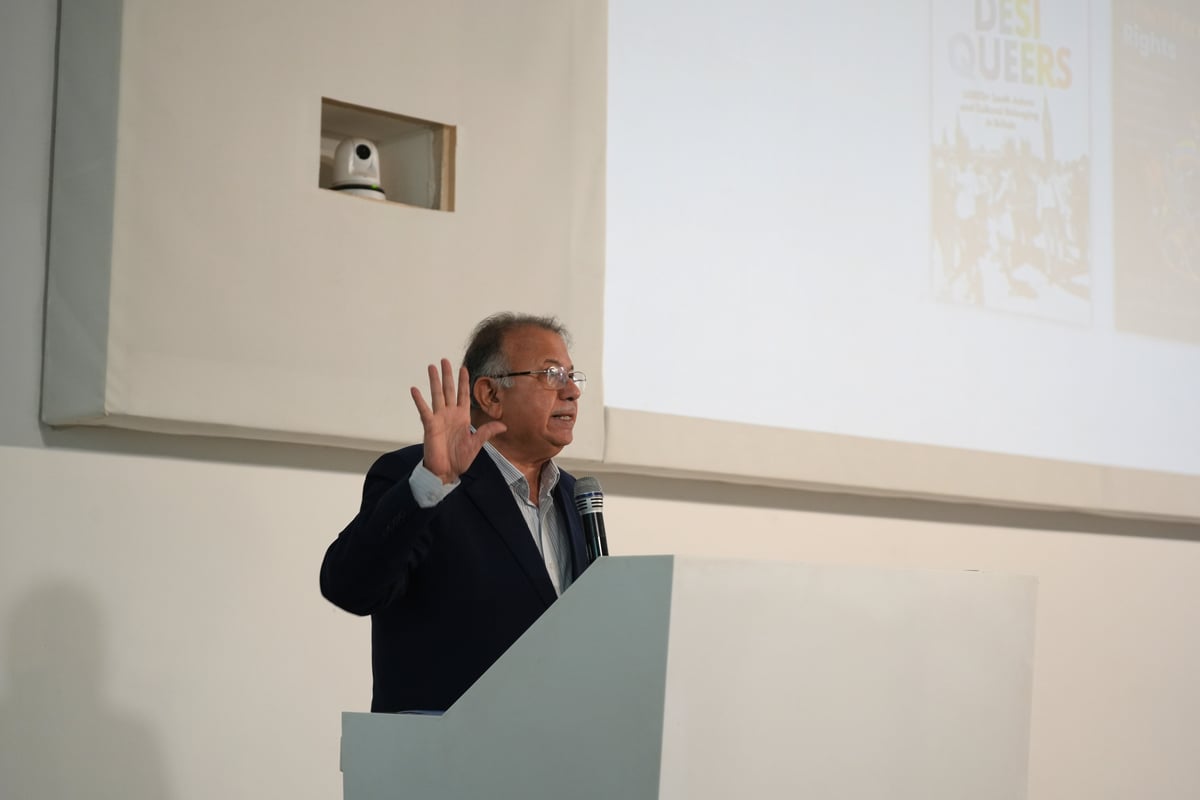
On June 1, 2026, at the start of International Pride Month, we hosted Pride @ Godrej 2026, an annual event with a special chief guest this year: Justice A.P. Shah, former Chief Justice of Delhi High Court and the Chairman of the Twentieth Law Commission of India. A widely respected figure in the legal community, Justice Shah’s contributions to India’s queer history are unparalleled. His stated commitments to constitutional values and his role in advancing LGBTQIA+ rights in India, most notably through the landmark 2009 Delhi High Court judgment which read down Section 377, meant that his presence at the event was meaningful to me and many queer folks and allies in the audience.
Justice Shah’s remarks to the audience highlighted how the judiciary has addressed the questions of fundamental rights for the LGBTQIA+ community in India. As I listened, I found myself reflecting not just on how far we’ve come, but how the queer leadership in India will take this journey forward. It was a mix of celebration and contemplation. On the one hand, we were witnessing a living archive of our realities across intersections through the launch of Queer India Now, an anthology edited by Dhrubo Jyoti and Dhamini Ratnam, with authors representing those multiple perspectives in the audience; and on the other, we were reflecting on recent developments in legislation that have proven to be a setback for the LGBTQIA+ community in India: the amendments to the law governing the transgender community, and the continuing lack of rights such as marriage equality.
Justice Shah started his address by speaking about the Constitution, and the promise of equality, dignity, and freedom for all. He traced the journey from the Naz Foundation judgement which initially struck down Section 377, to the setback from the Koushal decision in 2009 where Section 377 was briefly reinstated, and finally the landmark Navtej Singh Johar judgment in 2018, where the Supreme Court decriminalised homosexuality. He emphasised that as we moved from the colonial shadow of Section 377, whose aim was to protect “public morality,” to NALSA and Navetj, there has been a shift in the language used while referring to the LGBTQIA+ community – from criminality to dignity, and from invisibility to assertion.
Justice Shah spoke of the NALSA judgement, which upheld the “right of all persons to self-identify their gender” and which, in my estimation, may be the single most important judgement affirming one’s gender identity in Indian jurisprudence. Moreover, Justice Shah added that the NALSA judgement interpreted the right to equality to include “gender identity,” and extended freedom of speech to include the values of privacy, self-identity, and personal integrity. These declarations weren’t just legal milestones; they expanded how India understands identity itself, expanded the understanding of our rights as citizens, and strengthened the way we understand our constitutional values, including the right to privacy from the Puttuswamy judgement.
And yet, as Justice Shah reminded us in his address, “NALSA provided the right to self-identify, but the 2026 amendment to The Transgender Persons (Protection of Rights) Act, 2019, has undone this completely. The law itself was inadequate and even misconceived, particularly because it appears to have been drafted without the appropriate consultation with, or representation of actual stakeholders.”
The decriminalisation of homosexuality is only the beginning, Justice Shah said, reflecting on the judgement against Section 377 that he played such a pivotal role in bringing into effect. The next steps, in his view, are the formal recognition of marriage and family rights under law, and anti-discriminatory legislation.
I remember in October 2023 when the Supreme Court recognised same-sex relationships but left the question to Parliament regarding the formulation of the law. It was an anxious day, nervously checking the live feed of the case, knowing that while many of us were no longer criminals, our citizenship was yet to be fully realised.
It brought me back to two things – one, the brilliant paper “The State and The Construction of Non-normative Citizen” by the scholar Ditilekha Sharma, which discusses the construction of the Transgender Citizen through an examination of the NALSA Judgment, and two, the blog “A Queer-Trans Critique on Marriage Equality in India,” that I wrote a few years ago. Justice Shah in his address also emphasised the importance of “chosen families” as a structure of support for queer people who are at risk of violence and discrimination from biological kin.
While marriage comes with rights around inheritance, adoption, insurance and social recognition that are still out of reach for many, my blog opined that it must extend benefits to diverse forms of kinship that are removed from traditional family systems. Essentially, we need to envision marriage in a way that reimagines how law and society define loving, caring and living. Dhamini Ratnam, the co-editor of Queer India Now, echoed Justice Shah’s invocation of constitutional morality by pointing out that Dr. B.R. Ambedkar’s work on the Constitution is rooted in precisely these values of equality.
What stayed with me most from Justice Shah’s remarks is his emphasis that legal change alone is not enough. He said, “We need a pervasive acceptance and belief that LGBTQ persons are no different; that everyone possesses the same capacity to love, build lasting relationships, and be good parents.” And this is collective, community-oriented work. Justice Shah recalled the drafting of South Africa’s post-aparthed constitution – Nelson Mandela was not pro-gay rights to begin with and it was the young leadership of the African National Congress that convinced him that LGBTQIA+ rights are the same as human rights.
This anecdote made me think about leadership, specifically in the context of the queer community in India – who carries the work of advocacy and solidarity building forward? Who translates legal victories into lived realities? Who ensures that dignity is not just constitutional, but an everyday reality? I believe that some aspects of the answer lie with young queer leaders who can carry forward the rich legacy of queer elders who have charted a path for us. Any affirmative and inclusive change needs people who will question, build, organise and enable new inclusive queer futures. This is what we hope to enable through the Queer India Fellowship (QIF).
Earlier this year, on 14 April 2026 – the 135th birth anniversary of Dr B.R. Ambedkar – we launched Queer India Fellowship, a 12-month programme designed to advance India’s future queer leaders. As I listened to Justice Shah speak about the Constitution and its promise, and Dhamini invoking Babasaheb before her remarks, it felt especially meaningful to recall Ambedkar’s legacy in this moment.
More than a fellowship, QIF is an invitation to step into leadership at a time when the community needs it the most. Our aim is to enable and encourage queer leadership across diverse fields, especially those where such leadership has remained historically invisible and underrepresented. We envision that fellows will become change agents in different fields, while also learning from each other’s unique experiences.
If you are a young queer person with a vision for change, whether in your community, your workplace, your field, or beyond, this is your moment to step forward. To apply for the fellowship, click here. The last date for application is 30 June, 2026. If you have any queries, please write to queerindiafellowship@godrejfoundation.com.
I will close this essay with the same lines that Justice Shah quoted towards the closing of his address:
“Listen with ears of tolerance! See through the eyes of compassion! Speak with the language of love.”
– Rumi