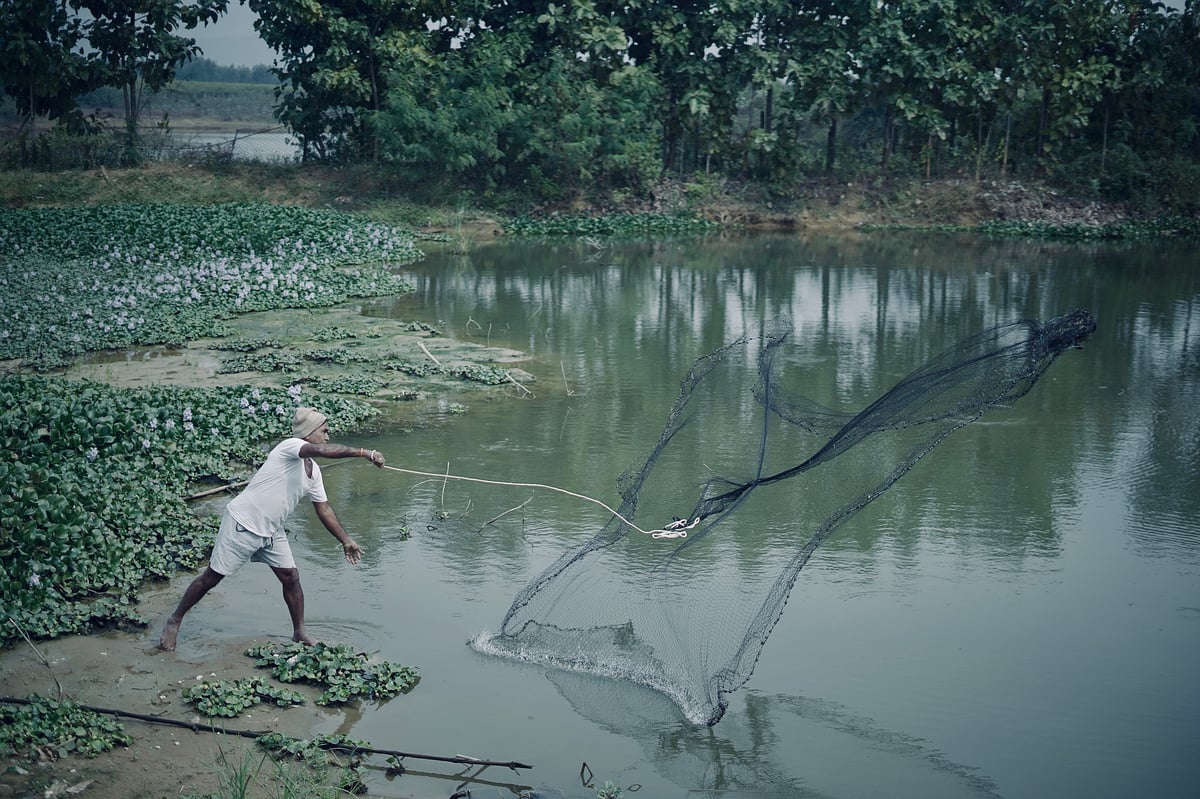
How Jaljeevika has turned water into a lifeline for farmers
From large women’s collectives to small-scale farmers, the Centre for Aquatic Livelihood Jaljeevika’s support for inland fisheries and integrated farming is giving a boost to rural household incomes.
The bidding began at ₹9,000, an amount that would ordinarily have been the closing bid for Mama Talao, a 16-acre village pond. It was December 2022, and Mama Talao was being auctioned at the Mul block office in Maharashtra’s Chandrapur district. It was not an ordinary auction.
Under the central government’s Matsya Sampada scheme to boost fishery-based livelihoods, local governments are allowed to auction ponds and lakes in their jurisdiction, leasing them for a short term to village-level cooperatives to enhance their incomes through fishery.
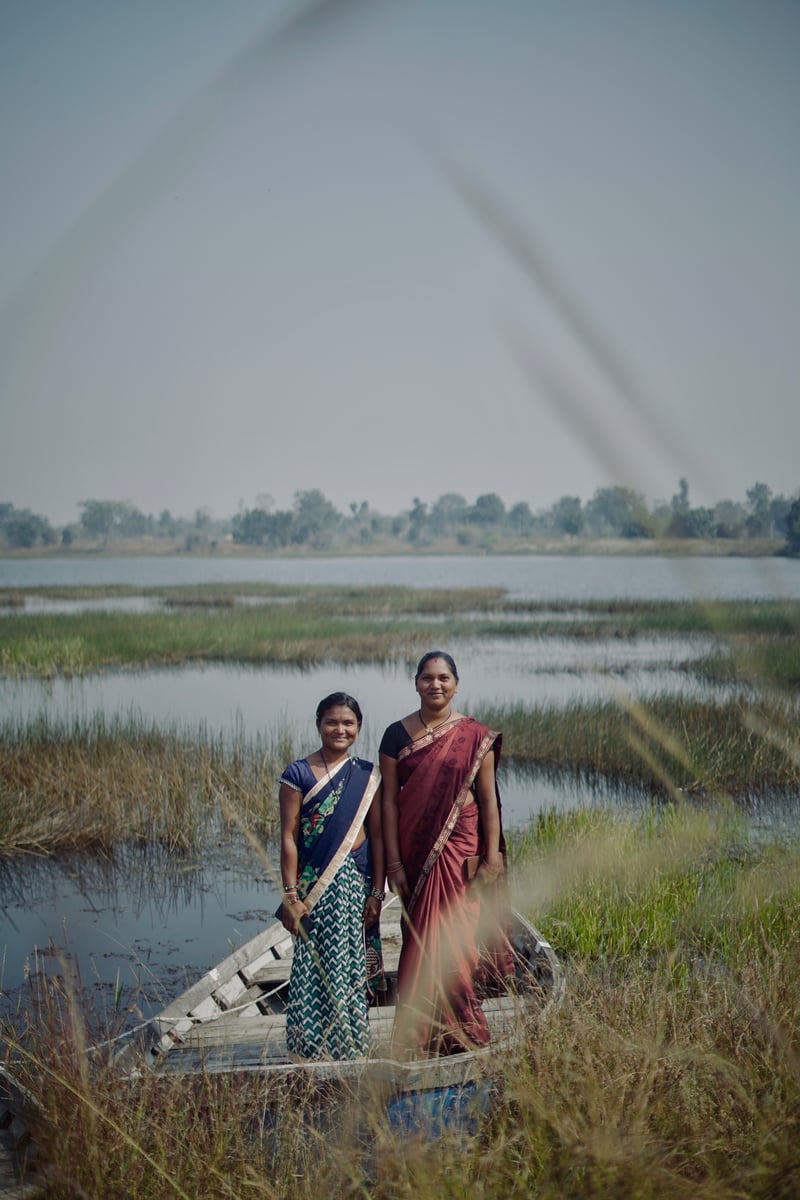
In 2022, for the first time ever, the usual fishing cooperatives, run by local men, faced new competition for the bid to Mama Talao in Chandrapur’s Bhagwanpur village. Specifically, it was competition from women – the 144 members of Prerna Mahila Gram Sangh, a collective of local women’s self-help groups.
Months before the December auction, when the collective first decided to throw its hat in the ring, men in the village had reacted with hostility. “They threatened us and regularly came to fight with us, demanding that we back out,” said Kiran Naitam, the chairperson of Prerna Mahila Gram Sangh. The fights and intimidation forced authorities to postpone the auction by a few weeks.
On the day of the final bidding, however, the women had the last word. They won the lease to Mama Talao with a closing bid of ₹71,000, nearly eight times more than the opening quote. Members of the collective – almost all of them from low-income households – each contributed a small amount to pay for the lease, and were granted rights over the pond, its fish and its profits for a period of three years. “In the first year after we won, men’s groups in the village imposed a boycott on us, and we couldn’t hire any local labourers to help us with fishing,” said Naitam. “But now they have accepted us.” Block officials confirmed that their lease is now set to be renewed for another term.
Prerna Mahila Gram Sangh’s landmark victory was the outcome of nearly 12 years of empowerment work by non-profit organisation Jaljeevika, in partnership with the Maharashtra government. Founded in 2013, Jaljeevika works with small-scale farmers and rural communities to promote aquatic livelihoods, specifically fish farming and aquaculture in inland water bodies. Their work involves a special focus on empowering rural women through water-based livelihoods. It has worked in eight states with over 45,000 farmers over the years, and its efforts to build strong fishery ecosystems have often involved collaborating with government stakeholders.
In eastern Maharashtra, Jaljeevika works with Manav Vikas Mission, the government’s human development initiative, and UMED, the state’s rural livelihoods mission. Both agencies help rural and backward communities with income generation activities, but neither had focused on water-based livelihoods until Jaljeevika came on as a technical and knowledge partner.
For instance, the organisation trained Manav Vikas’s district-level staff about the potential and opportunities in inland fishery. The state agency, in turn, began funding community-based cooperatives to construct ponds and hatcheries in at least 10 different locations in the region, and Jaljeevika’s field staff taught them how to operate them productively.
Traditionally, in the tribal belt of Vidarbha, women’s role in fishery was limited to selling fresh catch in local retail markets. In a bid to encourage more direct participation by women in the sector, Jaljeevika conceptualised UMED’s cadre of ‘matsya sakhis’ – women with basic training in various fishery activities who carry out local field visits to promote aquatic livelihoods. In the last 10 years, UMED has trained more than 1,500 matsya sakhis in Vidarbha, some of whom are members of Bhagwanpur’s Prerna Mahila Gram Sangh.
In 2022, UMED’s office in Mul block put its weight behind Prerna Mahila when the collective decided to vie for Mama Talao’s lease. It provided the group with an investment fund, backed them in the auction and brought in Jaljeevika’s expertise to increase the pond’s productivity. In the past four years, UMED and Jaljeevika have similarly empowered at least two other women’s collectives in Vidarbha to win leases for local ponds – one in Mul block’s Katwan village and another in Yavatmal district’s Ralegaon block. Across Maharashtra and its neighbouring states of Telangana and Andhra Pradesh, Jaljeevika is supporting more than 300 women’s groups to engage in fish farming and aquaculture.
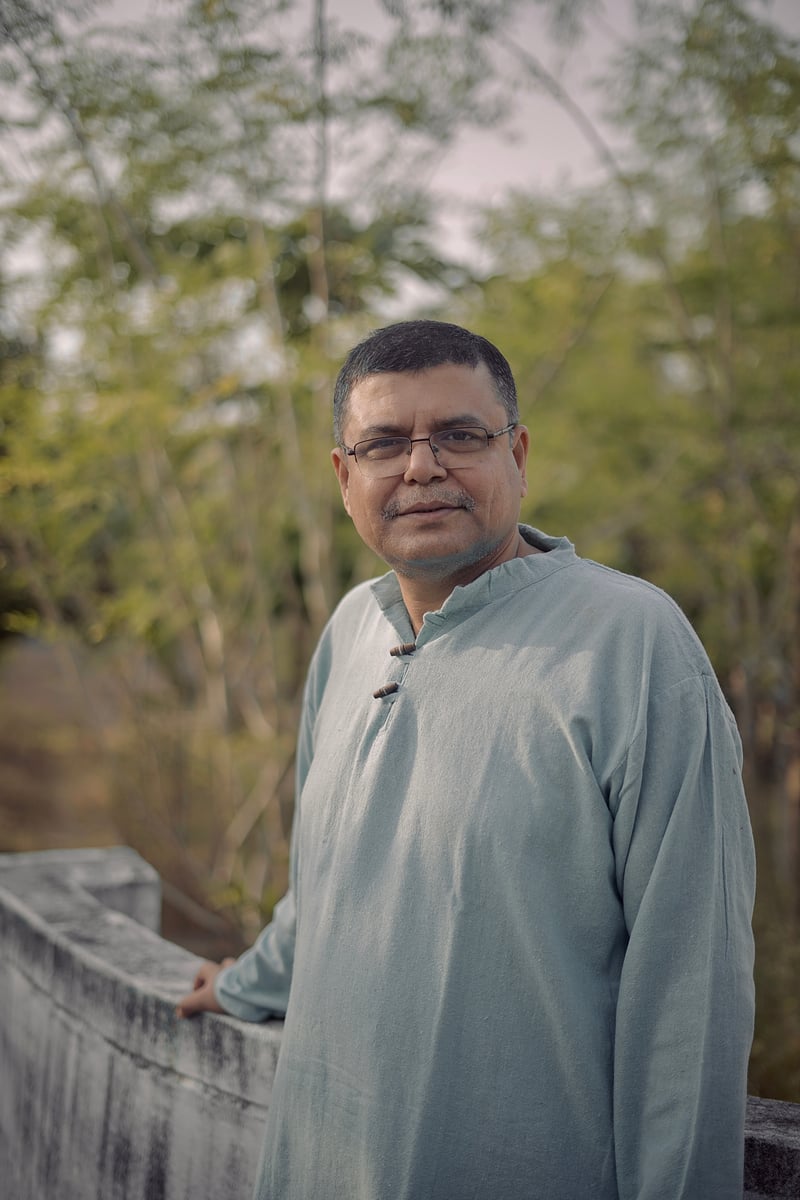
“There are a lot of untapped opportunities in the inland fisheries sector across India, and our aim is to help women and other small-scale farmers access them,” said Neelkanth Mishra, the co-founder and chief executive officer of Jaljeevika. “By developing livelihood models and creating entrepreneurship channels, we are helping them increase their household incomes significantly.”
Unexplored potential
Directly or indirectly, more than 28 million Indians depend on fisheries and aquaculture for their livelihood. India is the second-largest fish producing country in the world, after China, yielding 197 lakh tonnes of fish in 2024-25. Despite India’s extensive coastline, however, marine fishing forms just a quarter of the industry: 75% of the total national fish produce comes from inland fisheries – that is, fishing done in rivers, canals, lakes, ponds, reservoirs, floodplain wetlands and so on. Inland fish farmers constitute 82% of India’s fisher population.
These are high numbers, but they do not speak to the sheer potential of inland fishing. According to Jaljeevika, India has 7 million hectares of inland waterbodies, of which only two million have been brought under fish production. With the right effort, another 5 million hectares could be sustainably brought under fish farming and aquaculture, providing additional sources of livelihood for several million Indians. “A small pond with integrated farming models can help increase annual family incomes by ₹1 lakh to ₹1.5 lakh a year, with minimal investments,” said Neelkanth Mishra, an Ashoka Fellow who, before founding Jaljeevika, spent over a decade working with various non-profit organisations on agroecology, fishing and watershed management programmes.
While his education was in public policy, Mishra found himself drawn to the promise of inland fisheries during his stint at Oxfam in 2008-09. Bundelkhand and Bihar had suffered debilitating droughts and floods at the time, and while carrying out disaster relief work, Mishra noticed that local fishermen were able to sustain their livelihoods even as farmers struggled. “I realised that inland water bodies needed to be promoted as sources of food security, not just through fishing but also through farming a variety of grasses, algae, water hyacinth, and crops like lotuses and makhana,” he said.
Jaljeevika’s primary goal was to unlock those opportunities for farmers by making the best use of available and unexplored water resources.
Bhagwanpur’s Mama Talao, for instance, has the potential to produce 80-100 tonnes of fish annually. “But for all these years, the catch has been limited to 20-30 tonnes because farmers’ collectives relied on capture-based fishing instead of fish farming,” said Mishra.
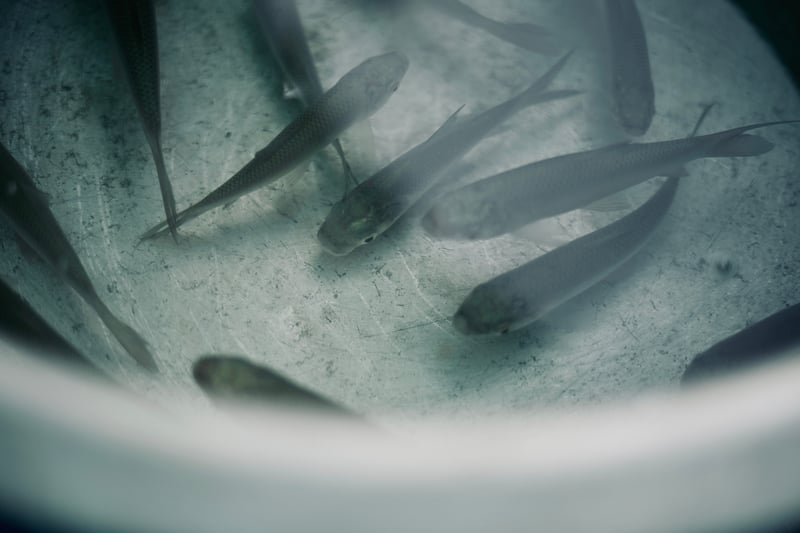
In order to quadruple production, the women of Prerna Mahila Gram Sangh needed to populate the pond with high-quality seeds and harvest them at the right time. With the help of UMED funds, Jaljeevika built a hatchery for the collective on a four-acre plot of rented wasteland near the pond. The hatchery apparatus comprises three concrete pools attached to a pumping system that circulates temperature- and nutrient-controlled water to thousands of ‘seeds,’ or fish spawn. The seeds – varieties of Indian carp species like catla, rohu and mrigala – are nurtured until they grow into ‘fingerlings’, around three to five inches in size. When these fingerlings are then moved into the pond, they have a much higher chance of thriving into robust adults weighing 5-10 kg.
Since members of the Prerna Mahila collective are still learning the ropes of seed farming from Jaljeevika, they have not yet started raking in larger profits. “We made around ₹2 lakh last year, which we have invested back into the business,” said Seema Madavi, the collective’s treasurer. The business, they explain, involves not only improving the quality and quantity of fish produced, but also strengthening their networks with the right markets, and addressing supply chain gaps.
“So far we have been selling our fish in smaller local markets because there aren’t enough cold storage and transportation facilities available for us to access bigger markets outside,” said Madavi. “But our own self-help groups could start cold storage businesses.” The women are keenly aware that this is a long-term economic model that will require patience and consistent input, but they have seen other farmer collectives prosper after adopting better fishing technology and investing in allied businesses, and are committed to putting in the work themselves.
Both UMED and Jaljeevika are keen to support the collective with these entrepreneurial ventures. The Jaljeevika team estimates that by 2027, each woman in the group will be able to earn an additional income of at least ₹50,000 annually, if not more.
Padmakar Bojja, the organisation’s programme director, pointed out that they have already achieved similar results in their work with several farmers’ fishing cooperatives. In Telangana’s Asifabad district, for instance, Jaljeevika has engaged 580 members of fishing cooperatives in the past three years, helping them improve seed quality, access government schemes, and learn better marketing techniques. “Many of these groups saw a 30% increase in sales after our interventions, and the added income means a lot for families who were earning just ₹30,000-40,000 from fisheries every year,” said Bojja.
A customised approach
Over 12 years in the field, the biggest insight the Jaljeevika team has gleaned is that there is no one-size-fits-all approach to developing water-based livelihoods for India’s rural population. Its field workers, who have either studied fisheries or are experienced farmers, devise different interventions based on topographical and practical factors in every region, district and village, sometimes customised right down to the level of individual farmers.
“The Gondwana region is drought-prone, so farmers always used to buy [fish] seeds from other states, which is more expensive,” said Bojja, referring to the tribal belt that runs through Maharashtra and Telangana. “People here were not aware that you can breed seeds even when there is water shortage, through many small and seasonal bodies of water. Every type of water body has its own utility.”
In the past three years, Jaljeevika has helped hundreds of local farmers set up their own seed farming enterprises as a supplementary trade. One of them is Bhikaru Bamne, a 50-year-old farmer from Asifabad’s Jagannathpur village. Even though Bamne comes from a traditional fishing community and has a small, natural pond on his farm, he had only ever engaged in subsistence capture fishery in the local river up until three years ago.
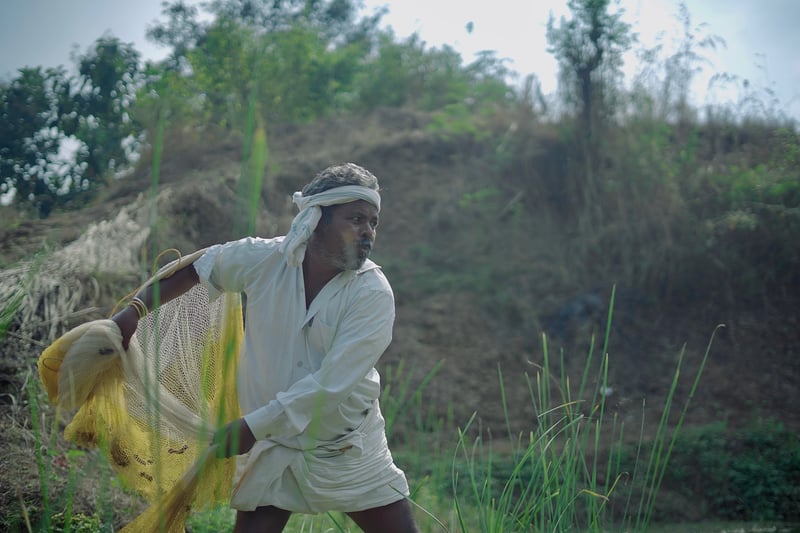
“Now, I have become a seed farmer,” Bamne said proudly. “Jaljeevika provided me with spawn the size of jeera [cumin], taught me how to grow them properly and sell them when they are bigger [as fingerlings].” Jaljeevika also supported him to construct a second, artificial pond on his farm so that he could breed a portion of his fingerlings into full-grown fish, for both household consumption and sale. “Now I make profits worth ₹2-3 lakh a year, which is much better than the unpredictable income from agriculture.”
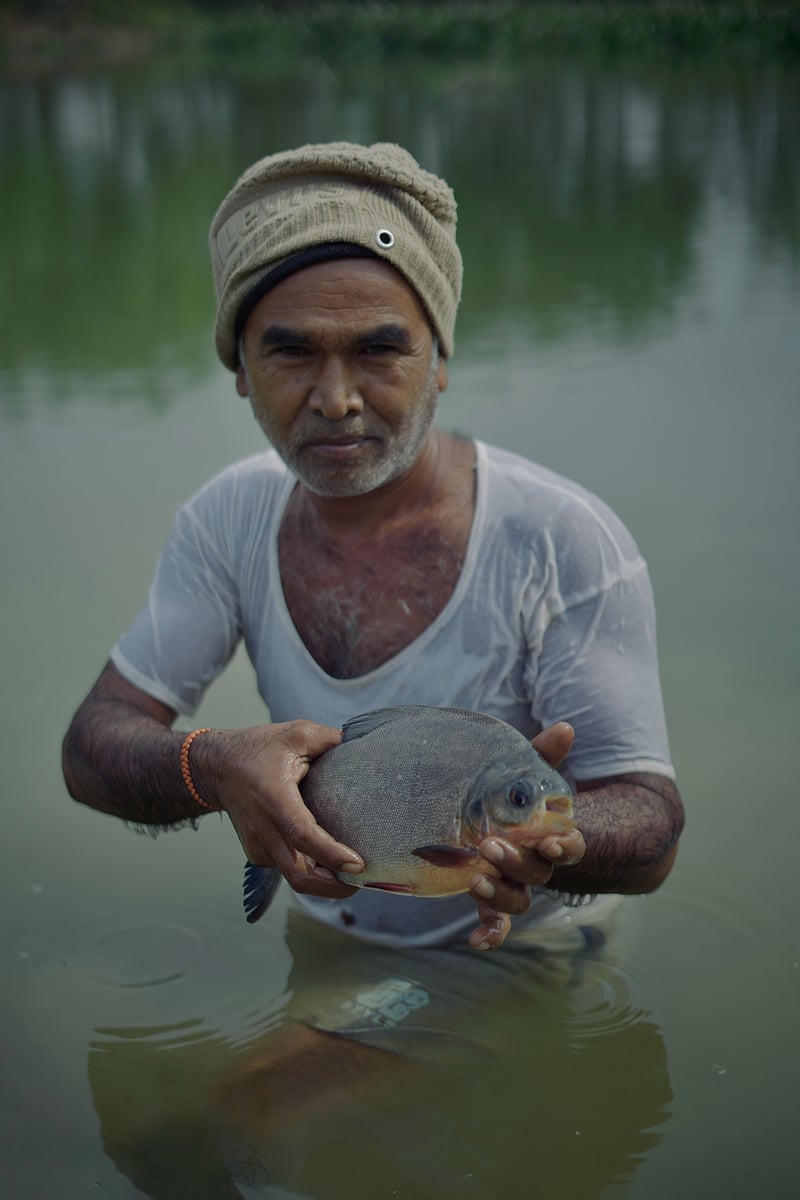
Half an hour away, in Nazrul Nagar village, farmer Gautam Mandal has now started purchasing fingerlings from local seed farmers like Bamne instead of importing them from other states. Mandal has a three acre farm on which his family grew foodgrains and cotton for years, but in order to raise six children, he also spent most of his life working odd jobs as a labourer. He started fish farming four years ago on a small, 8-foot deep pond on his farm, and realised it could bring in a considerable profit. “People from Jaljeevika started advising me two years ago, and since then my income has increased quite a lot,” Mandal said. “Their field workers come every two weeks to discuss the ways in which fishery and agriculture can be done in a coordinated way, and they have a lot of knowledge about which crops complement each other.”
This advice is part of the integrated livelihoods approach that Jaljeevika has dedicated itself to in recent years. Water, explains Mishra, is a lot more than a source of irrigation and a site for fishing – it’s an agricultural production unit in itself, which can generate income in myriad ways. Many farmers are not aware of the most productive or market-friendly ways to harness inland water resources, and Jaljeevika has stepped in to build both knowledge and capacity.
For instance, because of the soil quality of Mandal’s farm, they have advised him to alternate between harvesting fish and paddy in his pond every year, while growing a variety of vegetables along the banks of the pond. “This will help to renew the nutrients in both the soil and the water, and will give fish the right nourishment they need,” said Mishra. During our visit to the Mandal farm, Mishra pointed out the water hyacinths growing naturally and in abundance in the shallow edges of his ponds. “This plant is a good feed for the grasscarp fish, but you can also sell some of it for a high price in the market,” he told Mandal. “It has many different uses, in handicrafts, for example that we are now promoting.”
According to Swapnil Giride, the chief programme officer of the Science and Technology Resource Centre in Gadchiroli’s Gondwana University, Jaljeevika is able to have a significant impact on people’s livelihoods precisely because of the detailed attention it gives to small-scale initiatives. “There are very few organisations in India that work on fishing and aquaculture at the grassroots level,” said Giride. “Jaljeevika’s efforts to train, build scientific awareness and help small groups take ownership of their work, will be really helpful to build local industry.”
The models
In a bid to promote integrated farming in the Gondwana region, Jaljeevika has spent the past two years establishing model farms, as well as model farmers.
In Asifabad’s Kagaznagar town, the organisation has purchased a 2.5 acre farm that houses hatcheries for regional fish species, patches of organic farms growing a wide range of grain, fruits and flowers, as well as some of Jaljeevika’s own innovations, like affordable boats and a solar dryer for fish and vegetables. “We set this up as a model farm for locals to see how integrated farming can be done, as well as a training space to build their capacity,” said Mishra, whose team has trained at least 500 farmers from Asifabad and other districts at the farm.
Whenever Jaljeevika trains or engages with large numbers of farmers, a small percentage of proactive ones always step forward to seek further support for their own entrepreneurial ventures in fishing and integrated farming. Incubating such entrepreneurs by helping them access funds and technology has grown to be another key focus for the organisation.
One such entrepreneur is Kendria Balaji, the first organic farmer in Sirpur block in Asifabad. In 2015, after hearing about organic farming from others in the market, Balaji took to YouTube to teach himself how to convert his land from an ordinary farm to an organic one. By the time Jaljeevika met him in 2023, he was growing everything from grains, cotton and vegetables to fruits and flowers, in his tribal village, Dhanora, and was eager to begin fish farming as well.
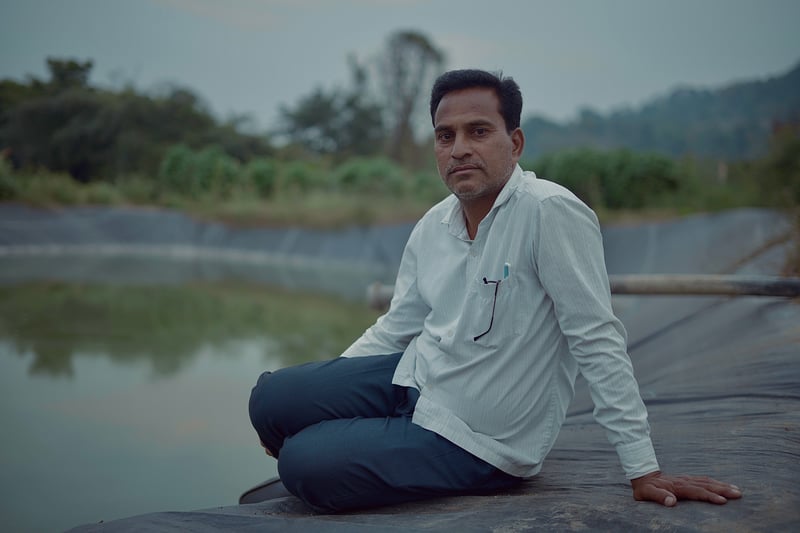
With the help of a government grant, he had constructed a small, 6-foot deep pond on his land, but found that the water would not hold – the soil was too porous. “Jaljeevika suggested lining the entire pond with a special tarpaulin to preserve the water, and also provided me with fingerlings,” said Balaji, who is looking forward to his first fish harvest this year. He has now joined the Jaljeevika team as a resource person, in charge of strengthening farmers’ collectives at the grassroots level.
While Balaji is not a small farmer – his family owns 20 acres of land – Jaljeevika believes supporting his ventures is crucial. “We have been trying to introduce fisheries in this part of the district for a while, and he was the first to take it up,” Bojja explained. Balaji’s adoption of organic farming has already prompted another 250 local farmers to make the switch, establishing him as an influential entrepreneur in the region. “We believe he can be a model farmer for fishing enterprises as well, and will inspire others to construct their own ponds. Since 90% of the farmers here are below the poverty line, added income through fishing could change their lives.”