Rural healthcare is the central focus of almost all the programmes on the campus of SEARCH, a veteran health research organisation in Maharashtra’s Gadchiroli district. But every few months, the campus fills up with around 200 young adults from across India – college students, early career professionals, entrepreneurs – who participate in week-long workshops that have an entirely different focus: social consciousness.
The workshops are conducted by Nirman, a youth initiative started by SEARCH in 2006 with the aim of helping young people find purpose in their lives and pursue social change more effectively. The sessions train participants to better understand themselves, social inequities and the values that inform socially-conscious decision making, among other things. Nirman has over 3,000 alumni, of which at least 750 now work full-time in the social sector.
Run jointly with the Maharashtra Knowledge Corporation Limited, Nirman is helmed by Amrut Bang, SEARCH’s joint director and the younger son of its founders, Dr Abhay and Dr Rani Bang.
In this interview, Bang, who’s a computer engineer by training and worked in the software industry before devoting himself to Nirman, spoke to us about the story behind Nirman. Edited excerpts:
How did Nirman originate and grow?
The original idea for Nirman came from my parents. As disciples of Gandhi, Vinoba Bhave and Jayaprakash Narayan, their primary goal was always to contribute to larger social change. Since they were doctors, they chose to do this through healthcare. Over time it became very apparent to them that young people in India are not getting enough exposure to social issues, and that something needs to be done about it.
They started Nirman as an experiment, to see if they could help youth become invested in working for social good. In the first cohort, they trained 60 people over two years. In 2008 we formalised the programme.
I think Nirman’s main pitch – ‘What’s your purpose?’ – is a question a lot of Gen-Z youth are asking themselves. They may or may not want to contribute full time towards social action, but many of them want to do something to address the problems they see around them. And we try to help them become more effective and systematic in their approach.
What do you mean by helping young people ‘flourish’?
A few years after I started working with Nirman, I began to feel that our programme was looking at young people as a means to achieve an end – getting them to participate in social action. But that is not how I wished to approach the programme. We consciously decided that we needed to look at the young people who come to Nirman as ends in themselves. We asked ourselves, how do we help them become saadhaks (seekers)? How do we help them grow, and how will that growth translate into some contribution for society?
For a child, indications of growth are easily measurable – height, weight, the age when they start walking and talking, etc. A child growing in a healthy manner is said to be flourishing. But what about youth in the 18-29 age group? How do we know if they are flourishing? I did the research and found no established framework to assess this. In the absence of a framework, only the visible markers become important, like which college are they in, how much did they score in exams, are they married?
But this is a very narrow-minded approach. Young people deserve a chance to flourish in other ways. That’s what I started working on at Nirman – detailing what growth to expect in the 26 crore young people in India.
So how does Nirman determine whether young people are flourishing?
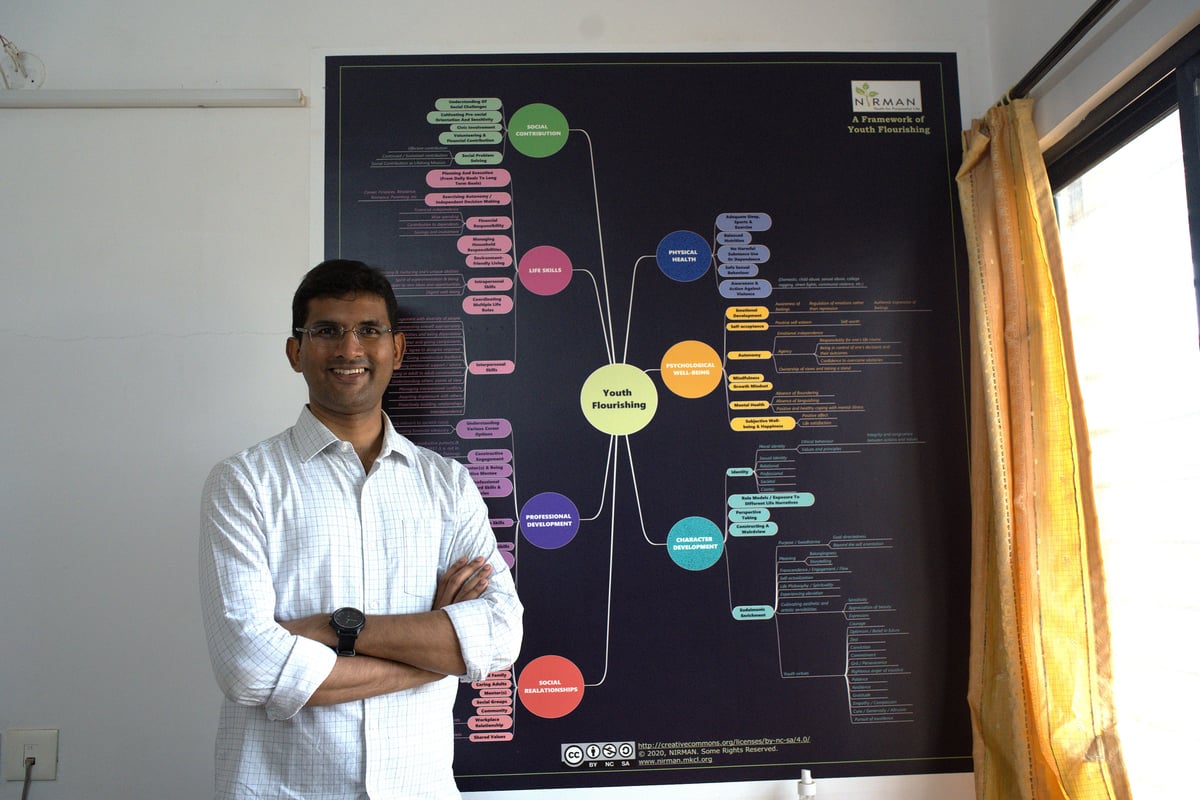
We created our own framework for this – the Nirman Framework of Youth Flourishing. It has seven domains: physical health, psychological well-being, character development, relationships, professional development, life skills and social contribution. We divided these domains into 50 features, based on which we created a questionnaire. The results give young people a domain-wise assessment of whether they are flourishing or languishing.
We recently analysed the data of 5,000 youth from across the country who were given the questionnaire under this framework, and found shocking figures. Only 9% of youth were doing well on all seven domains; 91% were languishing on at least one of the seven domains. And 54% were languishing in four or more of the domains.
We want to take this framework to more and more schools, maybe through the National Education Policy, which focuses a lot on holistic development. I would like colleges to also include flourishing goals in their syllabi.